Evan’s Arrest and Sentencing in Zurich
The Reincarnationist PapersEvan Michaels’s arrest in Zurich turns the apparent arrival of a newly admitted Cognomina member into the beginning of a long imprisonment. At customs, his fresh tattoo and dragon-headed cane draw attention; Interpol’s photographs then connect him to the gallery escape. His capture is followed by a brief Tunisian proceeding and a second, consecutive sentence in Rome, making his refusal to help recover Jan Vermeer’s The Rendezvous part of the formal basis for his punishment.
Arrival and Identification
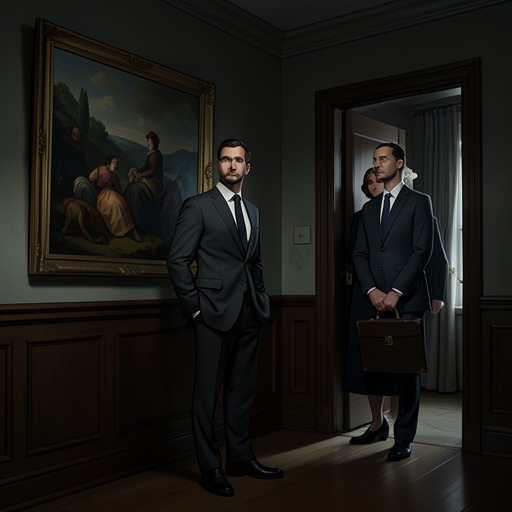
After the events of the preceding day, Evan arrives in Zurich exhausted but too excited to sleep during the flight. The city is familiar, yet the terminal seems newly vivid to him: its colors, floors, and passing faces all appear different. That altered outlook lasts only until customs. Asked whether he has anything to declare, he identifies cash and the cane in his right hand; when asked about his business in Switzerland, he says he has come for banking.
The customs agent looks from the cane’s dragon to Evan’s new tattoo and alerts a detective. The tattoo has particular significance in the immediate context: Evan has just accepted the Cognomina’s rules, including secrecy about the group and its condition, obligations toward other members, and a succession of identity trials across incarnations. The narrative places that private system of recognition beside the official scrutiny at the border, where the mark attracts attention but the decisive evidence is held in an Interpol file.
The Arrest at Customs
An Interpol officer approaches with a file. Evan asks whether there is a problem, but the customs agent cuffs his outstretched hand. Evan recoils and pulls against the officer; the Interpol agent brings him to the floor and secures the second cuff. In the struggle, the file spills open, exposing computer-reproduced black-and-white photographs of Evan.
The images show a sequence rather than a single glimpse: Evan hiding low, getting to his feet, and running toward the gallery’s back door. A strobe captured him at each stage, and the new tattoo is plainly visible in the photographs. The arrest thus makes the earlier escape legible as evidence gathered across successive moments. Evan is not identified merely by a suspicious answer or an unusual possession; the images connect his face and tattoo to the gallery incident, and the border encounter ends in custody before he can leave the customs area.
Sentences in Tunis and Rome
The account of imprisonment looks back on the arrest as the first stage of a worsening sequence. Evan describes the initial confinement as an encounter with an authority beyond his own control, then notes that the conditions became more barbarous and inhumane with each stop, first in Italy and then back in Tunisia. The movement between jurisdictions turns one arrest into a chain of custody and punishment rather than a single local case.
In the Tunis city jail, the proceeding that passes for Evan’s trial lasts fifteen minutes in a side room. He sees accusations gesticulated in Arabic, while his appearance is compared with the photographs; the sentence is translated into English. He receives twenty-five years with no parole. The brevity of the hearing stands in stark contrast to the length of the term, and the earlier images that enabled his arrest now serve again as part of the process against him.
Evan later learns that Rome tried him in absentia on the same day. That court also sentenced him to twenty-five years, to run consecutively, citing his refusal to cooperate in recovering The Rendezvous. The second sentence therefore does not overlap with the Tunisian term: it extends the punishment beyond it. Evan believes the painting will not be found, and by then he has already settled on a resolve that he thinks will carry him through his imprisonment.
Confinement and the Cost of Refusal
After the Tunisian sentence, Evan spends a sleepless night amid the sounds of other prisoners being interrogated. The next morning, guards transport him in an old bus whose windows are covered with welded steel plates. He and five other passengers can see only the soldiers accompanying them. As the bus travels over a crude road, heat builds inside the sealed vehicle; by midday, Evan focuses on dust filtering through openings in the roof. Near sunset, the bus stops at an isolated fortress of brown brick, with armed soldiers along its walls. This transfer carries the consequences of the sentence from the courtroom into a remote, restrictive place of detention.
The prison routine described there makes the conditions of custody concrete without diminishing the earlier legal sequence. A prisoner tells Evan that inmates receive two hours outdoors during the midday heat, are not made to work, and are subject to abuse. He advises Evan not to resist and gives rules for conserving drinking water, including when to use the chamber pot and how to drink safely from a rag. The speaker has nearly three years behind him and eight months remaining on his sentence. Against this daily regime, the initial arrest and hearing become only the threshold of a more prolonged confinement.
Significance
The episode brings two kinds of authority into sharp proximity. Before Evan reaches Zurich, the Cognomina’s rules have been presented as obligations binding on anyone who joins: secrecy, service to the collective, the surrender and eventual reclaiming of assets, and recurring tests of identity. At the border, Interpol and customs exercise a different authority, identifying Evan through the tattoo and photographic record, then carrying the case into courts that impose lengthy prison terms. The group’s obligations are framed as reciprocal duties within a family; the state proceedings culminate in incarceration, including a sentence tied specifically to his refusal to assist in recovering the painting.
The event also reverses the promise of Evan’s arrival. Zurich initially appears open and newly promising, and he travels there with the confidence of a person whose world has widened. Yet the gallery photographs already preserve the movements that led to his flight, and the tattoo he carries into customs helps bring those images back into the present. The arrest closes his immediate escape; the Tunisian and Roman sentences turn that capture into a prolonged consequence, while his refusal to cooperate remains the stated reason for an additional term.